
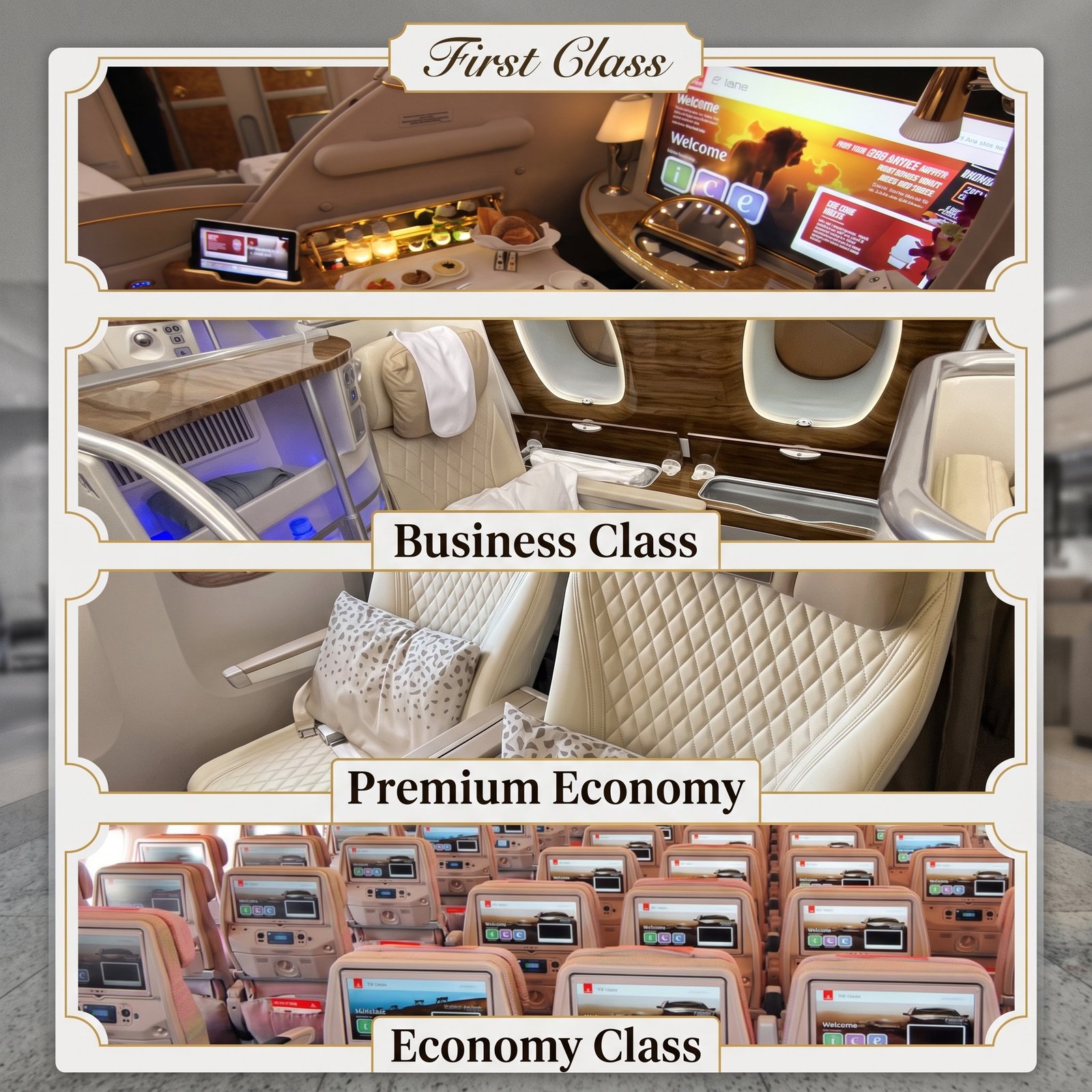
Emirates Economy, Premium Economy, Business or First Class? My Guide to Choosing the Right Emirates Class
I’ve flown Emirates in every class — Economy, Premium Economy, Business and First Class — on everything from short regional trips to long-haul flights. What follows is therefore not just a comparison of published benefits. It’s also my personal opinion, based on what I’ve experienced and how I decide whether paying—or using Miles—to upgrade is actually worth it.
And I don’t always upgrade.
Sometimes Economy is all you need. Sometimes Premium Economy is probably the smartest choice. On a long overnight flight, Business can completely change how you arrive. And First? That’s a different experience altogether, especially on the A380.
The real question isn’t simply which Emirates class is best?
It is: which class is worth it for this particular flight?
Flight duration, whether you’re travelling during the day or overnight, the aircraft, whether you’re travelling with children, the upgrade price and even whether you’re flying out of or back into Dubai can all change the answer.
Here is how I look at it.
Emirates Has Four Main Classes of Travel
Emirates currently offers four principal cabin experiences:
Economy Class
Premium Economy
Business Class
First Class
One important point: not every Emirates aircraft has every cabin.
Premium Economy, in particular, is being rolled out across the fleet as Emirates continues its major retrofit programme. That means two Emirates flights to the same destination can potentially offer quite different experiences.
So before I book—or especially before I pay for an upgrade—I check both the cabin and the aircraft.
That can make a big difference.
Emirates Economy Class: Better Than Many People Think
There is nothing wrong with flying Economy, particularly on shorter journeys.
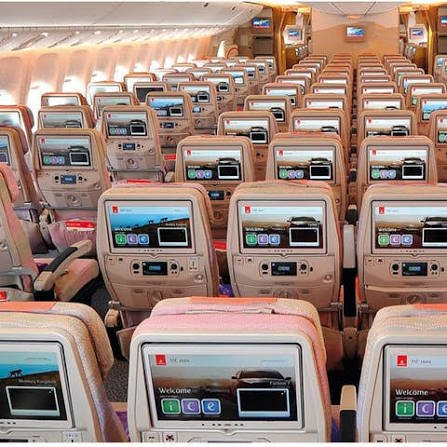
Emirates Economy gives you the airline’s ice entertainment system, meals and beverages, and a generally good long-haul Economy experience.
Your checked baggage allowance depends on the fare you purchase and the route. On many weight-concept routes, Economy allowances typically range from 20kg on Special fares up to 35kg on Flex Plus fares.
You can also choose between different types of seats, including Regular, Preferred, Twin and Extra Legroom, depending on the aircraft.
And this is one of my first upgrade tips.
Before upgrading cabins, upgrade your seat.
If I’m flying for three or four hours, I would seriously consider paying for an Extra Legroom Economy seat before spending substantially more for Business.
It won’t give you a lounge, champagne or a flat bed, obviously.
But on a short flight, you weren’t going to sleep for six hours anyway.
Sometimes a better Economy seat solves most of the comfort problem for a fraction of the cost.
When I would choose Economy
For flights under four hours, Economy is normally my first choice.
That includes many flights from Dubai around the GCC and nearby destinations.
If it’s a daytime flight, I’m travelling light and I’m going to spend perhaps three hours in the air, I would rather save the money for something else.
Emirates Premium Economy: Possibly the Sweet Spot
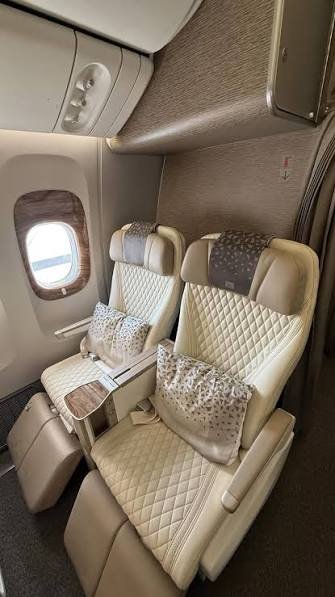
Premium Economy has changed the upgrade calculation considerably.
Previously, the decision was basically:
Economy or Business?
That’s a very large financial jump.
Premium Economy gives you something in between.
On Emirates’ A380, Premium Economy offers around a 40-inch seat pitch, approximately eight inches of recline, adjustable headrests and leg and footrests.
You also get a more premium dining experience, larger entertainment screens and considerably more personal space.
On the Emirates A350, Premium Economy uses a comfortable 2-3-2 configuration, which is also attractive for couples and families.
But it’s important to understand what you aren’t getting.
Premium Economy does not give you the full Business Class experience. You don’t automatically receive the Business lounge, Chauffeur-drive or, most importantly, a flat bed.
But do you need those things on every flight?
I don’t think so.
Where Premium Economy makes the most sense
For me, the sweet spot is approximately five to eight hours, particularly during the daytime.
You get significantly more comfort than Economy without paying Business Class prices.
If I’m flying six or seven hours during the day and don’t expect to sleep, Premium Economy can make much more sense than Business.
Emirates Business Class: You’re Really Buying Sleep
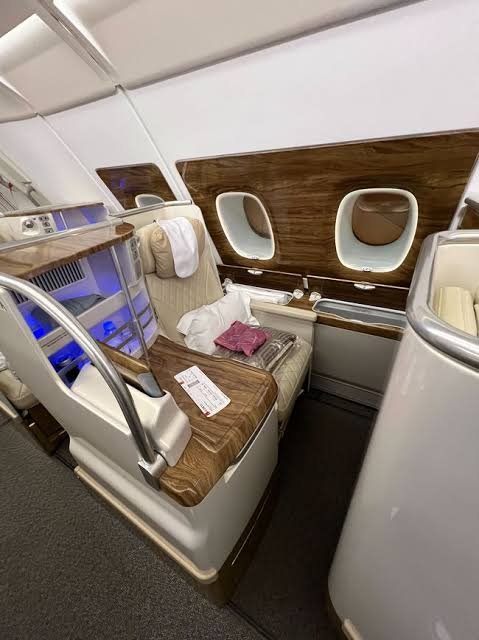
Business Class is where the Emirates experience changes considerably.
Yes, the food is better.
Yes, the drinks are better.
Yes, the service is more personalised.
And yes, the lounge is valuable.
But none of those is the main reason I would pay substantially more for Business.
The real value is sleep.
On the right aircraft, you can eat dinner, convert your seat into a flat bed, sleep for several hours, wake up, have breakfast and arrive ready to start your day.
That can completely change a business trip or holiday.
On long overnight flights, I don’t think about Business Class simply as buying a better airline seat.
I’m effectively buying a bed and several hours of my next day back.
That is a very different value proposition.
What Do You Get in Emirates Business Class?
Depending on your fare and route, Business Class can include:
-
Priority check-in
-
Priority boarding
-
Priority baggage handling
-
Higher baggage allowance
-
Emirates lounge access
-
Flat-bed seating on applicable aircraft
-
Premium meals and beverages
-
More privacy and personal space
-
Chauffeur-drive on eligible fares
-
Emirates A380 Onboard Lounge on applicable A380 flights
On many weight-concept routes, Business Class includes 40kg of checked baggage.
But there is something many travellers don’t realise.
Not Every Emirates Business Fare Has the Same Benefits
Emirates sells different Business fare types.
A cheaper Business fare may not include every benefit you associate with Business Class.
For example, Business Special fares have restrictions around complimentary lounge access and Chauffeur-drive, while Saver, Flex and Flex Plus generally provide more of the traditional Business benefits.
Similarly, upgrading from Economy using Skywards Miles doesn’t necessarily give you every ground benefit associated with purchasing a Business fare outright.
So don’t just look at:
Economy vs Business.
Look at:
Which Business fare am I actually buying, and what does it include?
That matters when calculating the real value of an upgrade.
Chauffeur-drive: One of the Benefits People Undervalue
If your Business or First Class fare qualifies, Emirates Chauffeur-drive is a very useful benefit.
Your premium experience can effectively begin before you reach the airport.
In Dubai, you’re collected and driven to DXB. On arrival at many destinations, you can also be driven from the airport to your hotel, home or meeting, subject to Emirates’ applicable distance and eligibility rules.
This changes how I calculate the value of Business Class.
If a fare includes:
Chauffeur-drive + priority check-in + lounge + premium flight + Chauffeur-drive at the destination,
you’re not simply buying a better seat.
You’re buying a door-to-door premium travel experience.
Emirates First Class: This Is About the Experience
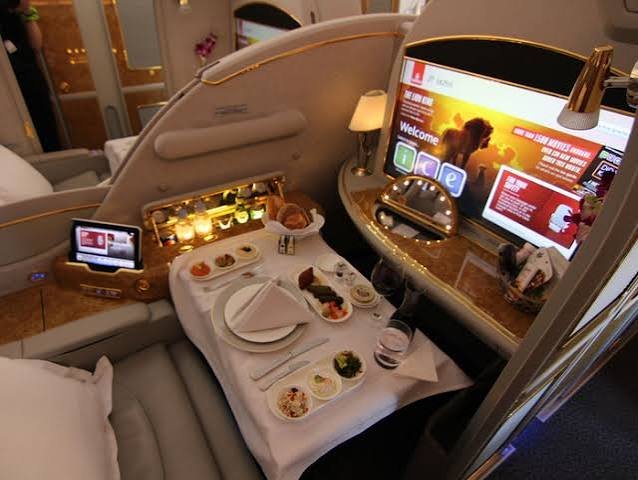
First Class is different.
I wouldn’t try to justify Emirates First purely by calculating the additional centimetres of space or the cost of the food and champagne.
First Class is an experience.
You get significantly more privacy, personalised service, premium dining and an environment designed around having your own space.
But if someone asked me:
“I want to experience Emirates First Class once. Which aircraft should I choose?”
My answer would be easy.
The A380.
That’s where Emirates First becomes particularly memorable.
You have the private suite and premium service, but you also get one of commercial aviation’s most unusual experiences:
The Emirates Shower Spa.
Taking a shower at 40,000 feet is completely unnecessary.
Which is precisely why it’s so memorable.
If you’re going to spend the money or Skywards Miles for a once-in-a-lifetime Emirates First experience, I would try very hard to make it an A380 First Class flight.
A380 vs Boeing 777 vs A350: Check the Aircraft Before You Upgrade
This is probably one of the most important pieces of advice in this article.
Never pay a significant Emirates upgrade without checking the aircraft.
The cabin name may be the same.
The experience may not be.
Emirates Airbus A380
If I’m paying personally for an Emirates premium cabin, the A380 is generally my first choice for the overall experience.
Business passengers can enjoy the famous Emirates Onboard Lounge, while First passengers get access to the Shower Spa.
The upper deck also gives Business and First a different atmosphere from most conventional widebody aircraft.
If I’m spending serious money on Business or First primarily for the experience, I would actively look for an A380-operated flight.
Emirates Boeing 777
Here you need to pay attention.
Not all Emirates 777 Business cabins are identical.
Older configurations can be very different from Emirates’ newly refurbished 777s.
The refurbished Boeing 777 Business Class features a 1-2-1 configuration, giving every passenger direct aisle access.
That is a substantial improvement.
If you’re looking at a 777 flight, check the seat map before booking or upgrading.
Emirates Airbus A350
The A350 is another aircraft I would happily choose.
Business Class is configured 1-2-1, while Premium Economy uses 2-3-2.
It’s modern, quiet and offers Emirates’ newest-generation cabin experience.
If my priority is sleep and comfort rather than having the A380 bar experience, the A350 is extremely attractive.
Travelling Emirates With Babies and Toddlers
This changes the equation considerably.
Emirates provides a number of useful family services, including bassinets subject to availability, baby meals, bottle warming, changing facilities and complimentary strollers at Dubai International Airport.
Children under two can travel as infants under the applicable Emirates rules, while children aged two and above require their own seat.
But here’s something I think parents should consider before automatically booking Business.
Business isn’t necessarily easier with a toddler.
With an infant who can use a bassinet, Business on a long-haul flight can be fantastic.
With an active two- or three-year-old?
It depends.
Some Business Class configurations give everyone a lot of individual space and privacy—which is wonderful when you’re travelling alone.
When you’re trying to manage a toddler, that same separation can become inconvenient.
Sometimes having everyone together in a Premium Economy row is easier.
And four Premium Economy tickets for a family can be considerably less expensive than four Business tickets.
So for families, I would seriously consider:
Premium Economy as the family sweet spot.
You get additional space without necessarily separating everyone into individual Business Class pods.
And let’s be realistic:
Business Class doesn’t guarantee that your toddler will sleep.
It may simply give them a more expensive place to stay awake.
How Long Should the Flight Be Before You Upgrade?
This is probably the question I get asked most.
There is no perfect answer, because price matters enormously.
But based on my own experience, this is roughly how I look at it.
Under 4 Hours
My choice: Economy
For most short regional flights, I don’t think Business is necessary.
If the upgrade is exceptionally cheap, that’s different.
But normally I would choose Economy and, if available and reasonably priced, pay for a better seat.
My recommendation: Economy + Extra Legroom if you want more comfort.
4 to 6 Hours
My choice: Economy or Premium Economy
This is where Premium Economy starts becoming interesting.
During the daytime, I don’t particularly need a flat bed.
Give me a larger seat, more legroom, better recline and some additional personal space and I’m happy.
If Premium Economy isn’t available, I would compare the cost of Business carefully.
Day flight: Economy/Premium Economy.
Night flight: Consider Business if the upgrade price is attractive.
6 to 8 Hours
This is where my decision becomes much more dependent on departure time.
Daytime: Premium Economy
If I’m awake for the entire journey, Premium Economy provides much of the comfort I actually need.
Overnight: Business
If I can realistically get four or five hours of sleep, Business suddenly becomes far more valuable.
This is where I’m no longer upgrading for luxury.
I’m upgrading for sleep.
More Than 8 Hours
My choice: Business if the budget allows
Once a flight passes eight hours, Business becomes much easier for me to justify.
At 10, 12, 14 or 16 hours, sitting upright becomes genuinely tiring.
If I’m travelling overnight and have meetings or activities after arrival, Business becomes even more valuable.
Premium Economy remains an excellent alternative when Business pricing becomes excessive.
My Emirates Flight-Time Rule
| Flight Duration | What I Would Choose | Why |
|---|---|---|
| Under 4 hours | Economy | Business benefits are difficult to maximise |
| 4–6 hours | Economy/Premium Economy | PE gives useful comfort without Business pricing |
| 6–8 hours daytime | Premium Economy | Probably the comfort/value sweet spot |
| 6–8 hours overnight | Business | Sleep starts becoming valuable |
| 8–10 hours | Business | Flat bed makes a meaningful difference |
| 10–12 hours | Business | Strong upgrade territory |
| 12+ hours | Business | This is where I would actively look for Miles/upgrades |
| First Class | Preferably A380 | If you’re doing it, enjoy the full experience |
How Much Is an Upgrade Actually Worth?
Emirates upgrade prices vary enormously.
They depend on your route, date, original ticket, fare bucket, availability, demand and whether you’re using cash or Skywards Miles.
So I don’t believe there is a universal answer such as:
“Never pay more than AED 2,000 for Business.”
Instead, I use a simple calculation.
Calculate Your Upgrade Cost Per Flying Hour
Imagine your upgrade costs AED 4,000.
On a four-hour flight:
AED 1,000 per flying hour.
On a 14-hour flight:
About AED 286 per flying hour.
Same upgrade price.
Completely different value.
Now add another factor.
If that 14-hour Business flight allows you to sleep six hours and arrive functional the following morning, what are those six hours worth to you?
That’s why I find Business much easier to justify as flight duration increases.
How to Get the Best Emirates Upgrades
There is no guaranteed trick that magically produces cheap Emirates Business seats.
But there are things I do.
1. Join Emirates Skywards
Even if you’re not a weekly Emirates traveller, having a Skywards account gives you opportunities to use Miles for upgrades.
Depending on the ticket and availability, upgrades can be possible between Economy, Premium Economy, Business and First.
2. Keep Checking Manage Your Booking
Don’t check once and give up.
Upgrade availability changes.
Seats open.
Inventory changes.
Passengers change flights.
Keep checking.
3. Activate Upgrade Alerts
Where available, Emirates can notify you when upgrade availability appears.
Use it.
4. Compare the Upgrade Against Buying Business Directly
This sounds obvious, but people sometimes become obsessed with finding an “upgrade”.
Check the Business fare separately.
I’ve seen situations where buying the higher cabin makes more sense than purchasing Economy and then upgrading it.
5. Upgrade the Longest Sector
If your journey has multiple flights, I would prioritise the longest one.
I’d rather use Miles upgrading an eight-hour overnight sector than spend them on a 90-minute regional flight.
6. Look at the Aircraft Before Spending Miles
If you have flexibility, look for:
A380 – best overall Emirates premium experience.
A350 – excellent modern Business and Premium Economy product.
Refurbished 777 – particularly attractive because of the newer 1-2-1 Business layout.
I would be less enthusiastic about spending a large number of Miles upgrading to an older Business configuration when a better aircraft is available at a similar time.
7. Look at Flight Times, Not Just Flight Numbers
A 7:00am departure and 2:00am departure to the same destination aren’t worth the same Business upgrade to me.
If I’m going to sleep, the flat bed becomes much more valuable.
Should You Upgrade Leaving Dubai or Coming Back Into Dubai?
This is an interesting one.
If both flights are roughly the same duration and both are daytime flights, I would generally choose:
Upgrade leaving Dubai.
Why?
Because Dubai is Emirates’ home.
This is where you can experience the airline’s premium ground product properly.
On an eligible Business fare, your journey can start with Chauffeur-drive.
Then premium check-in.
Then the Emirates lounge at Terminal 3.
You can eat, work, shower or relax before boarding.
Then you have the premium onboard experience.
So your six-hour Business flight isn’t really just six hours of premium travel.
The overall experience might start several hours earlier.
That adds value.
But There Is One Big Exception: Overnight Flights
Sleep beats the lounge.
Imagine your choices are:
Dubai → Europe at 9:00am
or
Europe → Dubai late at night.
If I could only upgrade one, I would seriously consider upgrading the flight back into Dubai.
Why?
Because I can sleep.
Landing in Dubai at 7:00am after five or six hours of proper sleep is far more valuable to me than enjoying a Business lounge before a daytime flight.
So my rule is simple:
Similar flight times?
Upgrade departing Dubai.
One flight is overnight?
Upgrade the overnight flight.
One sector is substantially longer?
Upgrade the longer sector.
Sleep and time usually beat champagne and lounges.
Which Emirates Class Offers the Best Value?
This might surprise some people.
Best Overall Value: Premium Economy
For many travellers, I think Premium Economy is becoming the smartest Emirates cabin.
You get a meaningful improvement in comfort without making the enormous financial jump into Business.
For six- to eight-hour daytime flights, it’s very difficult to argue against.
Best Long-Haul Value: Business
Once you’re flying eight, ten or twelve hours—particularly overnight—Business makes much more sense.
You’re paying for sleep, privacy and how you feel after landing.
Best Short-Haul Value: Economy
Three hours?
I’m perfectly happy in Economy.
Put me in a good seat and save the money.
Best Experience: First Class
First isn’t really about value.
It’s about experience.
And if I’m going to do it, I want the A380.
Economy, Premium Economy, Business and First: Quick Comparison
| Benefit | Economy | Premium Economy | Business | First |
|---|---|---|---|---|
| Meals | Yes | Enhanced | Premium | Premium/on-demand style |
| ice entertainment | Yes | Yes | Yes | Yes |
| Extra personal space | Standard | Significant | Very high | Exceptional |
| Flat bed | No | No | Yes on applicable product | Yes |
| Lounge | No* | No* | Yes on eligible fares | Yes |
| Chauffeur-drive | No | No | Eligible fares | Eligible fares |
| Priority check-in | Standard | Enhanced where applicable | Yes | Yes |
| A380 Onboard Lounge | No | No | Yes | Yes |
| A380 Shower Spa | No | No | No | Yes |
| Best use | Short flights | Medium/long daytime | Long/overnight | Experience/luxury |
*Paid or status-based access may be possible depending on Emirates Skywards status, airport and applicable rules.
What I Would Personally Book
If I were booking Emirates tomorrow, this would be my rough decision:
Dubai to Riyadh, Kuwait, Bahrain, Muscat or similar:
Economy.
Four to six hours during the day:
Economy or Premium Economy.
Six to eight hours during the day:
Premium Economy.
Six to eight hours overnight:
Business if the price makes sense.
Eight-plus hours:
Business if my budget allows.
Twelve-plus hours:
I would actively look for Business upgrade opportunities or Skywards availability.
Travelling with young children:
I would seriously consider Premium Economy before automatically buying Business.
First Class:
I would try to make it an A380.
Only one upgrade available on a return journey:
I would upgrade the overnight or longest flight first. If everything else is equal, I would choose the flight departing Dubai to maximise the Emirates ground experience.
Final Verdict: Don’t Upgrade Just Because You Can
Having flown all four Emirates cabins, I’ve learned that the most expensive seat isn’t automatically the smartest seat.
There are short flights where Economy makes complete sense.
There are medium-haul flights where Premium Economy gives you almost everything you genuinely need.
There are overnight flights where Business is worth considerably more because you can sleep.
And there are occasions where First Class isn’t about value at all—you’re doing it because you want the experience.
Before paying for any upgrade, I would ask five questions:
How long am I actually flying?
Is the flight daytime or overnight?
Which aircraft am I flying?
What benefits does my specific fare include?
How much am I paying per hour for the upgrade?
And if you remember only one tip from this article, make it this:
Don’t buy the cabin name. Buy the hours of comfort you’re actually going to use.
Sometimes the right answer is Emirates First Class on an A380.
Sometimes it’s Business and six hours of uninterrupted sleep.
Sometimes it’s Premium Economy.
And sometimes it’s simply a good Economy seat—with several thousand dirhams still sitting safely in your bank account.