
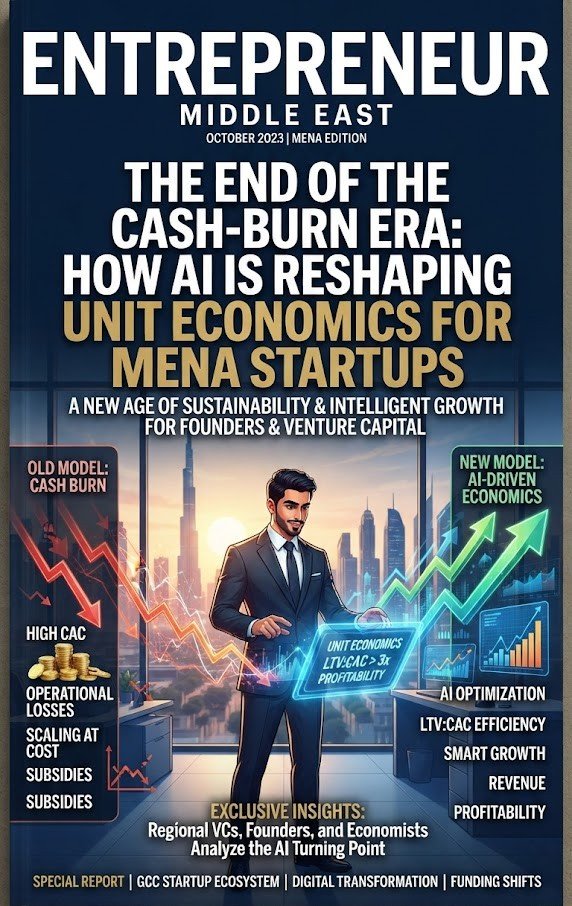
The End of the Cash-Burn Era: How AI is Reshaping Unit Economics for MENA Startups
Goodbye to the 50-person team: How the new “Value Architects” are building high-margin, billion-dollar enterprises on micro-operational footprints.
For the better part of a decade, startup success in the Middle East and North Africa (MENA) was measured by a flawed vanity metric: headcount. In the old venture capital playbook, a founder’s prestige scaled linearly with the number of desks in their Riyadh or Dubai headquarters. “Growth at all costs” was the mantra, fueled by cheap capital and an acceptance of staggering operational burn rates.
That era is officially over.
Today, institutional investors and venture capital funds have fundamentally altered their scorecards. In a landscape dominated by capital efficiency and scrutiny over burn multiples, a new breed of founders—the Value Architects—is rewriting the rules of corporate scaling. By deploying autonomous, agentic AI workflows rather than hiring bloated middle-management tiers, these leaders are breaking the linear relationship between revenue growth and operational expenditure (OPEX).
The result? Micro-teams of fewer than 15 people generating the annual recurring revenue (ARR) and EBITDA margins that once required a workforce of 200.
The Paradigm Shift: From Headcount Vanity to Capital Efficiency
The traditional startup playbook relied on throwing human capital at operational bottlenecks. If customer onboarding was slow, you hired more account managers. If financial reconciliation lagged, you expanded the accounting department. While this brute-force scaling drove top-line growth, it crippled Unit Economics, leaving companies vulnerable to market contractions.
In 2026, the competitive edge lies in zero-marginal-cost scaling. When a startup integrates decentralized AI agents into its backend infrastructure—connecting live databases, payment gateways, and ERPs via automated webhooks—the cost of servicing the 1,000th client becomes nearly identical to servicing the 10th.
This transformation moves AI out of the realm of IT spending and firmly into strategic corporate finance, directly impacting three core financial pillars:
1. LTV/CAC Compression & Payback Acceleration
Customer Acquisition Cost (CAC) has historically been the silent killer of regional startups. By automating lead scoring, predictive churn analysis, and personalized onboarding through agentic workflows, value-driven startups are drastically reducing acquisition friction. When an AI agent nurtures a lead from inquiry to conversion without human intervention, the LTV/CAC ratio expands organically, shrinking the CAC Payback Period from an industry average of 12 months down to less than 90 days.
2. Operating Leverage and Margin Expansion
When operational workflows (such as invoicing, vendor matching, and customer support tiering) are handled by interconnected AI agents, fixed personnel costs are converted into highly predictable, scalable computing infrastructure. This creates unprecedented operating leverage. As revenue climbs, OPEX remains flat, allowing gross margins to expand rapidly and pushing EBITDA into positive territory years ahead of traditional projections.
3. Premium Valuation Multipliers in M&A and Series A/B
Venture capitalists no longer value startups solely on gross merchandise value (GMV) or top-line ARR. Today, the ultimate valuation driver is ARR per Employee. A company generating $10 million in ARR with 12 employees commands a significantly higher revenue multiple than a competitor generating the same revenue with 120 employees. The lean startup is viewed as inherently more resilient, agile, and profitable at scale.
Field Case Study: How a MENA FinTech SaaS Tripled ARR and Secured a 12x Valuation Multiple with a Frozen Headcount
To understand the mathematical power of AI-driven unit economics, examine the trajectory of a Riyadh-based B2B FinTech SaaS platform specializing in automated cash-flow management for mid-sized enterprises:
-
The Before State (The Labor-Intensive Trap): In early 2025, the company had reached $3.5 million in ARR but was burning through $300,000 monthly. Their customer onboarding required manual credit checks, manual ERP integrations, and a dedicated team of 24 onboarding specialists.
-
The Financial Reality: Their LTV/CAC ratio hovered at a mediocre 2.2x, CAC payback took 11 months, and their net operating margin was deeply negative. To reach their next growth target, the legacy operational plan called for doubling the headcount, which would have accelerated their cash burn to dangerous levels.
-
-
The Strategic Pivot (Agentic Backend Architecture): Instead of raising a bridge round to hire more staff, the management team instituted a strict headcount freeze and deployed an AI-powered operational overhaul. They replaced manual processing with two core agentic workflows:
-
The Autonomous Onboarding Agent: A workflow integrating financial APIs that automatically pulls client bank statements, conducts real-time credit scoring, and maps accounting ledgers in 8 minutes (down from 7 business days).
-
The Predictive Risk & Cash-Flow Agent: A backend daemon that continuously monitors client transaction velocity, automatically generating variance reports and financial alerts without human analyst input.
-
-
The Financial Yield (The Numbers): Within seven months of deploying this infrastructure, the company’s unit economics underwent a structural transformation:
-
Marginal Cost Collapse: The cost to onboard and maintain a new corporate client plunged by 78%.
-
Payback & LTV Surge: With acquisition friction eliminated and automated engagement driving retention, the LTV/CAC ratio leaped to 6.4x, while the CAC Payback Period dropped to just 2.8 months.
-
The Valuation Leap: The startup scaled its ARR from $3.5 million to $10.8 million over 12 months—without adding a single operational employee. Their ARR per employee skyrocketed to over $700,000. When closing their Series B round, institutional investors awarded the company a 12x ARR valuation multiple, compared to the 5x–6x multiples assigned to their labor-heavy regional peers.
-
The Executive Takeaway: AI did not add value to this startup because it was a trendy technology; it created billions in enterprise value because it structurally broke the linear link between revenue growth and operational costs.
The New Scorecard for Founders and VCs
We are witnessing the democratization of scale. The barrier to building a scalable, high-margin enterprise is no longer access to massive capital to fund armies of staff; it is the strategic capability to architect intelligent, self-executing business systems.
For founders and CFOs across the region, the strategic mandate is clear: review every departmental workflow not as a human staffing challenge, but as an optimization puzzle. The ultimate question for your next board meeting is no longer, “How many people do we need to hire to reach $20 million in ARR?”
Instead, it must be: “How do we architect our agentic infrastructure so that our current core team can scale to $20 million while maximizing our free cash flow and EBITDA multiple?” Those who solve this equation will define the next decade of MENA economic prosperity.