
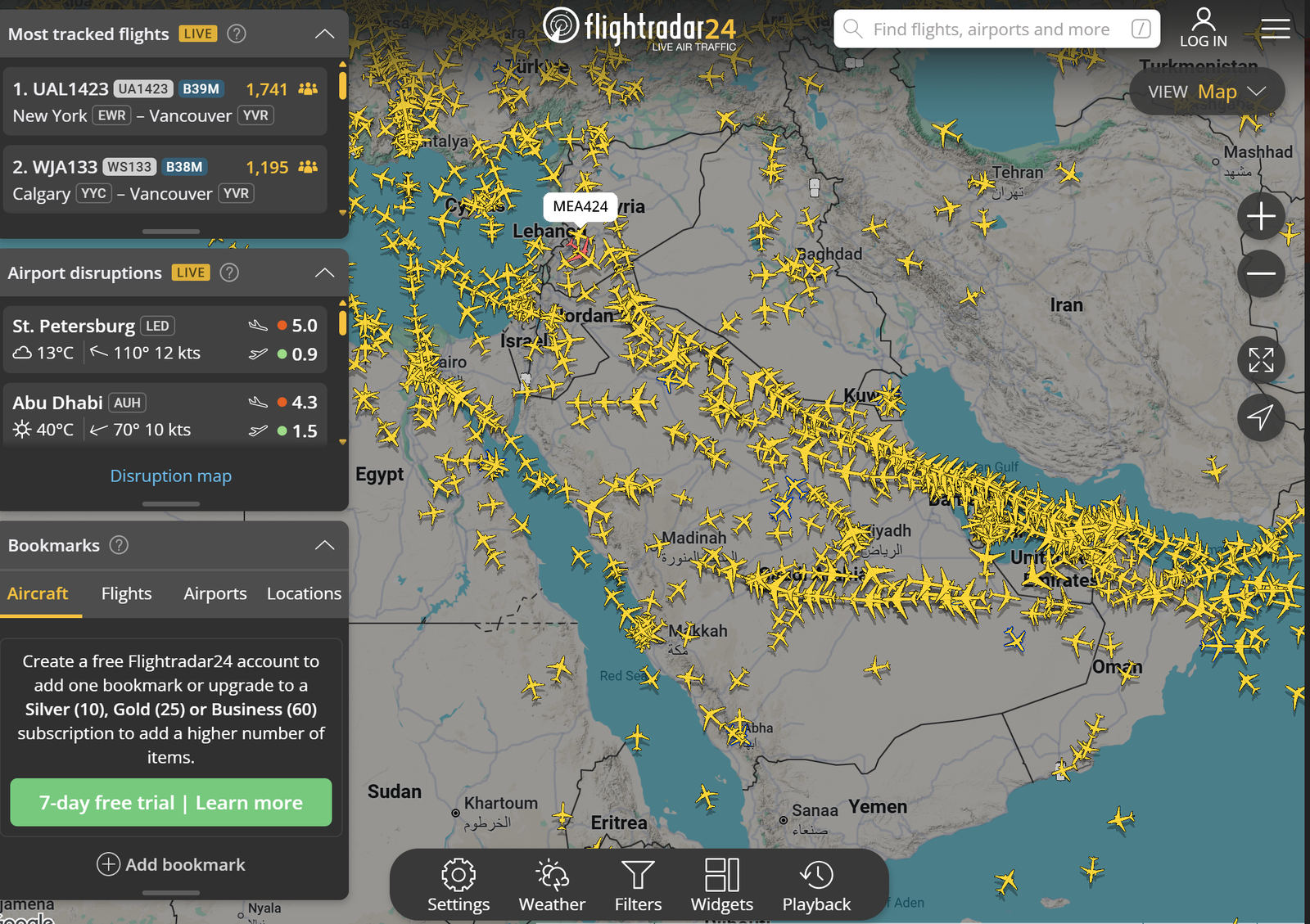
Still Doubting Dubai and the GCC? Look at the Sky.
I was checking Flightradar24 and this caught my attention. Look at the number of planes over the UAE and the Gulf.
And then we keep hearing the same question: Is Dubai slowing down? Has the UAE peaked? Is the GCC growth story exaggerated?
I don’t think so.
Of course, you can’t measure an economy from a Flightradar24 screenshot. Many of these planes are crossing the region rather than landing here. But you also can’t ignore what this picture represents.
People are moving. Tourists are coming. Business travellers are flying in and out. Cargo is moving. Airlines are adding capacity. Airports are busy.
And you can feel the same thing when you’re on the ground.
Try driving through Dubai during rush hour. Try getting a restaurant reservation on a busy weekend. Look at the hotels, events, new offices, construction sites and the number of companies continuing to enter the market.
Yes, the traffic drives us crazy. I complain about it too 😅. But I’ll take traffic over empty roads any day, unless I am running late for a meeting.
The more interesting story, though, is that this is no longer only about Dubai.
Spend some time in Riyadh and you immediately feel the pace there as well. Saudi Arabia is changing incredibly fast. Abu Dhabi continues to grow its position in business, finance, tourism and technology. Qatar remains a major regional hub. Bahrain and Oman are developing their own opportunities. The GCC as a whole feels busier.
That doesn’t mean business is easy. Actually, I think it’s becoming harder.
There is more competition. Costs are higher. Clients expect more. Consumers have more choices. Companies need to work harder for the same business, and strategies that worked five years ago don’t necessarily work today.
But a competitive market and a declining market are two very different things.
What we’re seeing across the GCC is a market becoming bigger, more mature and much more competitive.
Dubai has always benefited from its location. You can reach Europe, Asia, Africa and most of the Middle East within a few hours. Add Emirates, Etihad, Qatar Airways, flydubai and the region’s growing airline networks, and you start to understand why the Gulf has become such an important global crossroads.
But there is something else happening now.
Dubai, Abu Dhabi, Riyadh, Jeddah, Doha, Manama and Muscat are becoming increasingly connected parts of a much bigger GCC business ecosystem.
People move between them. Companies operate across them. Capital moves between them. Talent moves between them.
So when people ask me whether Dubai has “rebounded,” I’m not sure rebound is even the right word.
The market has changed. The opportunity has changed. And the competition has definitely changed.
You can’t run a business in 2026 using the same thinking you used in 2019 and expect the same results.
But is the opportunity still here?
Just look at the sky.
Sometimes a screenshot says more than another 50-page market report.